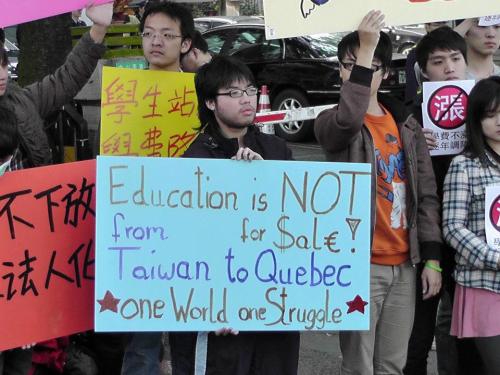
This weeks readings looked at Jeffrey Martin’s article “A Reasonable Balance of law and Sentiment: Social Order in Democratic Taiwan from the Policeman’s Point of view”. The article examines social order by using a new and interesting point of view, that of policeman. Based on this article I decided to look at police conduct within Quebec and more specifically in the city of Montreal based on a native’s perspective, compared to police conduct as stated in Martin’s article.
Within the province of Quebec the main police force is La Sûreté du Québec, which is the main unit responsible for almost eveything within the province, although many municipalities may have their own police force and the except of Montreal which has the SPVM (Service de Police de la Ville de Montréal). Montreal is known for many different reasons, Expo 67, Biodome, Marché Bonsecours, Old Forum, Montreal Canadians, F1, Charbonneau Commision and more recently police brutality within the context of protests (CTV Montreal, 2014).
When walking around Montreal you are certain to see a police officer, whether it be by car, bike, foot or horse, they are everywhere in Montreal. The most recent clash between demonstrators and police took place during the Police Anti-Brutality Protest, which took place on March 15th, where people gatheres to “publicly voice their opposition to excessive use of police force-or to call for the disbanding of armed police forces altogether” (The Link, 2014). This is an annual event in its 18th year, however, unlike most year this years protest was declared illegal mere minutes after it started due to municipal bylaws put into effect during the Maple Spring or the Montreal 2012 Student Protest (The Link, 2014). It seems that it has become expected that the SPVM kettle protestors, pepper spray them and conduct themselves in a way unacceptable of people with authority over others, compared to Taiwanesse officers there is a stark difference. In Taiwan, specifically in Taipei county the policemen have their own beat in which it consits of a couple of city blocks, containing about 200-400 households, and a sole officer is responsible for this (Martin, 2007). There seems to be very little conflict between Taiwainesse policemen and their citizens, even though each policemen is responsible for their beat, they know the people and regularly interact with them. This system of course isn’t feasible for all places and cities, however, it seems to be effective in Taiwan and other cities could learn a lot from Taipei County’s police system.
From a native’s perspective, I think the SPVM have a tough job and they tend to get a lot of critism for doing their job. An example, is during the Maple Spring most police offficers worked double shifts and did plenty of overtime due to the ongoing protest. No job is ever easy and I think being a police officer in a large city has its challenges, we live in a society where free speech is rampant leading to everyone being able to freely express their opinion. People will always have their opinions, however, perhaps taking a look at the SPVM and making changes would be benificial not only for the police officers but also for the citizens of Montreal.
Image Source:
Panda Costume: http://blogs.montrealgazette.com/2013/03/07/the-story-so-far-lachine-hospital-stays-with-muhc-and-protests-are-killing-downtown/
Taipei Police: http://english.tcpd.taipei.gov.tw/GIPDSD/xslGip/xslExport/108002/%E8%AD%A6%E5%AF%9F%E5%B1%80%E8%8B%B1%E6%96%87%E7%89%88%E5%9E%8B1/images/%5B1%5Dlogo_tcpd.png
References:
CTV Montreal. (2014, March 15). Montreal police hand out 288 fines, arrest five during anti-police brutality protest. Retrieved from http://montreal.ctvnews.ca/montreal-police-hand-out-288-fines-arrest-five-during-anti-police-brutality-protest-1.1730803
The Link. (2014, March 18). Editorial: The spvm’s bylaw squad. Retrieved from http://thelinknewspaper.ca/article/5713
Martin, Jeffrey. 2007. “A Reasonable Balance of Law and Sentiment: Social Order in Democratic Taiwan from the Policeman’s Point of View.” Law & Society Review 41 (3): 665-697.
Sunday, March 23, 2014
Sunday, March 9, 2014
The Cult of Wang Yulan and Nationalism
In article by Chang-hui Chi “The Death of a Virgin:
the Cult of Wang Yulan and Nationalism in Jinmen, Taiwan”, the author talks
about the death of a woman named Wang Yulan who a symbolic complex was built
around her to prevent the spread of communism. They used her as a means to
promote nationalism within the village to ensure that order was respected.
As a Quebecer I find it quite interesting that Wang Yulan
was used as a symbol to promote nationalism since I feel that currently with
the Quebec elections Pauline Marois is being used as a symbol to also promote
nationalism. Although the nationalism both are being used as symbols for are
quite different, and only one of the women actually has a say in what they’re
promoting since Wang Yulan was only being used as a symbolic complex after her
body washed ashore in Jinmen.
Politicians
will use anything they can get their hands on in order to promote their own
agendas, in both cases nationalism was their goal. Currently in Quebec the
Parti Quebecois’s main goal is to be elected as a majority in order to have
absolute power within the National Assembly in order to further promote their
own agenda and their ultimate goal is to pass a referendum to sepearate from
Canada. Their strategy is to gain support from the “True French Canadians” in
order for the Parti Quebecois to be elected as a majority and have ultimate
power within the National Assembly. However, in Taiwan in order to promote
their nationalist agenda they used Wang Yulan and promoted her worship where
her body was round and made her the symbol of resistance to communism and the
exemplar of traditional Chinese values in general (2009; 671). Their main
strategy became to use traditional values in order to gain support and
encourage people to join them in the resistance against any sort of change, as
a means to promote and ensure that the countries core values don’t waiver.
Both
Quebec and Taiwan are fighting for the right to become their own countries and
not have other people made decisions on their behave and allow others to
dictate what their laws and value system should be. Although, to an outsider to
seems that Taiwan is it’s own country, I’m sure within Taiwan its people do not
feel the same way, however from a Quebecer’s perspective unlike Taiwan we own a
Canadian passport and are part of a country, whereas Taiwan keeps getting
shifted back and forth from Japan’s hands to China’s without their input.
Taiwanese nationalism as well as Quebec nationalism is a sense of pride of
where one comes from, it shows your origins and allows people to identify with
a specific set of customs.
Image Source:
Quebec
Nationalism - http://thepoliticalbouillon.com/en/wp-content/uploads/2012/12/Flag_Map_of_Canada_with_Independent_Quebec.png
Taiwan
Nationalism - http://img208.imageshack.us/img208/2953/taiwanisnotchinawn1.jpg
References:
Chi, Chang-hui. 2009. “The Death of
a Virgin: the Cult of Wang Yulan and Nationalism in Jinmen, Taiwan.” Anthropological Quarterly 82
(3): 669-690.
Sunday, February 16, 2014
Identities and Nationalism
Benedict Anderson's article "Western Nationalism and Eastern Nationalism: Is There a Difference that Matters?” she takes a look at nationalism now and then as well as Western vs. Eastern. There’s this idea according to Anderson that an Asian form of nationalism is still very much so common and it has roots going back more than a century. This idea’s origins come from racist European imperialism, which felt that East is East and West is West, meaning that they were not only very different but they would also never meet or intertwine due to their differences (2001: 31). Some of the oldest nationalism in Asia are in fact older than many of those in Europe and Europe Overseas. In fact several countries in their origins were very similar to other countries in which they have very little in common with each other, such as the Philippines and Cuba, they are both in the Northern Hemisphere but are classified as East and West (2001: 32).
One of the most predominant points mentioned in the article is how often the world changes and how over time the notion of East and West has varied substantially from how people viewed it a century ago to how they view it in modern times. Another important question that we need to ask ourselves is who decides where east and west begin and end, is there a science behind this decision making process or is it arbitrary since it changes so much over time (2001: 32). Can countries within the same time zone be the limitations of East and West, or must they be in the same Hemisphere for this decision to be made, an example of this is Lima and Los Angeles both in the same time zone could they both be regarded as the Far West. Centuries ago migration wasn’t look at as an issue however now there are massive amounts of population migrations taking place within the supposedly fixed boundaries of Europe and Asia allowing people to leave their home countries and settle in others, bringing their values and beliefs along with them (2001: 32).
These migration flows will most likely continue and perhaps even accelerate over the years, since even though some countries have stricter laws and regulations in most countries immigrants make up its demographic profile and they’re essential to the countries development and prosperity. What comes out of these migrations, what new identities are being or will be produced, these questions are hugely complex and large unanswerable questions because these migrations are still so new, in past decades very few people would migrate outside of their own country less so continent (2001: 33). Anderson goes on to discuss the concept of Creole Nationalism, which is the earliest form of nationalism, arose out of the vast expansion of overseas empires, which were often very far away. She goes on to talk about linguistic nationalism, which has its philosophical origins in the theories of Herder and Rousseau, who’s “underlying belief was that each true nation was marked off by its own peculiar language and literary culture, which together expressed that people’s historical genius” (2001: 40). In the end there are multiple forms of nationalism each, which has roots within the others, there seems to be no distinct nationalism because they all have similarities even though they may be predominantly Western or Eastern.
Image Source:
Albert Einstein: http://thefabweb.com/wp-content/uploads/2012/06/t6gAx-900x506.png
Migration Flow: http://www.leeds.ac.uk/strikingwomen/skin/images/map_large.jpg
References:
Anderson, Benedict. 2001. “Western Nationalism and Eastern Nationalism.” New Left Review 9: 31-42.
Monday, February 10, 2014
Experiences of Being a 'Native'
In Keelung Hong’s article “Experiences
of Being a ‘Native’: Observing Anthropology” he talks about growing up in
Taiwan when it was then a Japanese colony and then the experience of it
becoming a Chinese colony. He makes reference to Native Americans and their experience
during the time of residential schooling in Canada, looking at how classmates
were turned into spies and would turn on them if they dare speak their native
language and not acculturate to speaking Chinese (1994:6). They were striped of
not only their language but also of their identity, cities and villages were
renamed, punishments were enforced if someone dare spoke their native language
even simply to pronounce a friends name or their own name. The Chinese people
who took over Taiwan ensured that there would be no remnants of Taiwanese
society when they were done, acculturation was in full force and it became
important that people learned to obey by the new laws (1994:6).
For most Taiwanese people the only means of
having a better life is to leave Taiwan in order to get away from the oppressive
Chinese oligarchy, in the case of Keelung it meant immigrating to the United
States once he had completed his mandatory military service. Once he began his
study in the United States he was able to get a hold of ethnographies written
about Taiwanese villages, much to his surprise the ethnographies although
written about Taiwan were actually looking at ‘traditional Chinese culture’,
most ethnographers did not actually look at Taiwanese culture but rather would
go to Taiwan in order to study what they felt was Chinese culture (1994:7).
Keelung explains that one of the reasons behind most ethnographers going to do
fieldwork in Taiwan about Chinese culture was because China was closed to
researchers, however, when research became available in China most of them
flocked to China in order to have a large study population. One of the main
points in his article is about Margery Wolf’s research, which he calls into
question because he feels like a lot of her research was romantized and wasn’t
accurately portrayed (1994:7).
Keelung Hong’s view of Taiwan is quite
interesting because unlike ethnographies, which give an outsiders first hand experience
of a culture, he is able to give outsiders a real look and feel for what Taiwan
culture rather then Taiwan culture through the Chinese cultural scope. Hong’s
outlook made me as an anthropology student reconsider all of the ethnographies
I have read over the course of my schooling, it makes me think perhaps how skewed
what I’ve read really is and how those cultures must feel when they read such
things. The notion that perhaps not all ethnographies accurately portray the society
properly brings up the issue of how as a reader we’re supposed to know if the
information being presented to us is correct and actually factual regarding the
society.
Image Sources:
Taiwan Retrocession 1947: http://65th.tpg.gov.tw/history-pic/glorious-moment/images/6-37.jpg
References:
Hong, K. 1994. “Experiences
of being a ‘native’: observing anthropology”. Anthropology today. 10 (3): 6-9.
Friday, February 7, 2014
Chinese Family Firm
The article written by Susan
Greenhalgh “De-Orientalizing the Chinese Family Firm”, she talks about family
businesses and how family is involved in these businesses. She did her field
research based on a historical study on 25 Taiwanese-run, manufacturing-based businesses;
her primary focus was from the late 1970’s. The majority of the information
Greenhalgh gathered came from a series of lengthy and intensive interviews
conducted with the entrepreneurs and members of their families (1994: 752). The
25 businesses looked at were from a wide range of size classes; there were five
sizes, microenterprises (1-19 workers), small in scale (20-99), medium sized
(100-499), large (500-999), and finally very large (1,000 or more employees).
Within these 25 businesses Greenhalgh looked at how families were involved and
how many were involved depending on their different sizes (1994: 752). In the
article table 1 shows how many family members worked within the different
companies on average though it was found that each business employed 5.0 family
members however it was found that the smaller the business the larger the
family work force. The numbers diminished significantly between micro and
small-scale businesses from 6.1 to 4.3 in very large businesses, most businesses
was also predominantly male oriented, very few women worked in the businesses
it went from 2.6 in micro and small-scale to 0.9 in very large businesses
(1994: 753).
Greenhalgh goes on in her article to describe how there were many gender
differences were apparent in the conditions and rewards in the family business,
virtually all male kin would work full-time whereas only one out of two female
kin worked on a part-time basis. The majority of men received salaries whereas
among the females in the businesses only unmarried daughters and married women
working on the production line regularly received monetary compensation and
even with this most of the men would work on a full-time basis whereas for
married women their work was like an extension of their reproductive
activities, part-time and uncompensated labor (1994:754).
After reading this I found it quite disturbing how female workers were
treated and even more so since the majority of these working women had kinship
ties to the businesses how they received little to no compensation for the work
they put it. This article seems highly inaccurate in the portrayal of how
female family workers are treated mainly I think because she only looked at 25
family run businesses which isn’t really enough to be able to do any kind of
accurate research surrounding the topic. I hope that since this research and
field work was conducted that things have changed for females working within
the family business because there is no equality in their treatment regarding
pay and work conditions.
Image
Source:
Family: http://publishing.cdlib.org/ucpressebooks/data/13030/57/ft3q2nb257/figures/ft3q2nb257_00012.jpg
References:
Greenhalgh,
S. (1994). De-orientalizing the chinese family firm. American ethnologist,
21(4), 746-775. doi: 10.1525/ae.1994.21.4.02a00050
Thursday, January 30, 2014
Gods, Ghosts, and Ancestors
In Arthur Wolf’s book “Studies in
Chinese Society”, there’s a section called “Gods, Ghosts, and Ancestors”. It
describes the worship rituals in the everyday lives of people living in the
rural areas along the southwestern edge of the Taipei Basin. Wolf starts by
describing how each morning conservative families will burn three sticks of
incense twice a day, the first is placed in a nice outside of the house for the
benefit of the wandering ghosts, the second is dedicated to the Stove God whose
images resides above a large brick structure where all meals are prepared and
finally, the third is placed in a burner before the tablets of the family’s
immediate ancestors (1974: 131). His entire essay goes on to explain how these
three different acts of worship have their own significance in the lives of the
Taiwanese people, his arguments in the essay revolve around how each
worshippers conception of the social world places a significant role in their
lives (1974: 131).
The first act of worship
involves the Stove God, in most northern Taiwanese homes there is a large brick
cooking stove on which most of the families’ meals are prepared and it stands
as a substantial symbol of the family as a corporate body. This stove
possession identifies the family as an independent entity, this is of great
importance because the owning of your individual family stove shows that you
are independent and independent families never share a stove (1974: 133). Wolf
goes on to explain how when brothers divide the father`s household, the eldest inherits
the stove and the younger brothers will take hot coals from that said to their
own stoves as a welcoming act to the stove god into their home. If a stove is
contaminated with insects then it must be demolished and the bricks thrown into
a river in order to restore peace for the family, there is thus a very apparent
association not only between Stove God and stove but also between god and
family (1974: 133).
As someone who grew up in a western
society in a Catholic household, I think it`s really interesting how much
emphasis is put on a god and worshipping your ancestors, I grew up with the
notion of their only being one god. However, my world view has evolved a great
deal and I no longer really view one religion as being higher than another. I
think there is merit in every religious practice, it may be hard to understand
a different person`s belief system but I find this particular God worship
system to be particularly intriguing. I think it’s quite interesting how Gods
who have failed at their duties are tried and condemned to a public beating, whereas
in the Catholic faith if God doesn’t do something for his followers it’s
because he had another life plan for us and we don`t question him. While in Taiwan
culture a god was tried for neglecting his duties and condemned where he was
left in the hot sun to see how he liked it and finally after enduring all sorts
of insults as broken in pieces (1974: 144). I am aware no every sub-culture
within Taiwan share the same belief system the one Wolf takes about from a
Westerners standpoint is quite impressive how they will punish a God for being
neglectful whereas we simply accept it and decide it must be part of a bigger
life plan God has for us.
Image Source:
References:
Wolf,
A. (1974). Studies in Chinese Society. Stanford, CA: Stanford University
Press.
Friday, January 24, 2014
Ethnology of the Southwestern Pacific
In Toichi
Mabuchi’s article “Ethnology of the Southwestern Pacific”, he talks about the
concept of life sphere’s as well as how the change in social shift became a
large area of study for him (1974: 175). Although when he began his studies he
had no concrete idea about what the social shift distribution was. Mabuchi
feels that the Institute of Ethnography has become handicapped by three
different factors: research staff, research funds and the deadline for
publishing results (1974: 176). As a result, of this he felt it better to begin
studying the oral history of the Formosa rather than the cultural history since
oral history came before anything was written meaning it had been around for a
longer period of time. While he began his research Mabuchi became more and more
interested in the “folk knowledge” of the Formosa, which included the oral
history, encompassing both synchronic and diachronic dimensions within the
society (1974: 176). Rapid change has occurred for the Formosa aborigines in
regards to their culture and society during and after WWII, this resulted in it
being very hard for research to now work within the aboriginal state.
Most cultural activities within the Formosa are performed
on a spatial base and such a base is demarcated by cultural activities (1974:
177). This base will then have geographical extensions and this connection
allows for the people to have knowledge specific to their area and culture.
This bond is quite flexible and varies depending on the cultural activities,
however, in societies where intercultural exchange is more brisk and the
differentiation of profession and status is more conspicuous making it often
hard to demarcate the geographical spheres (1974: 177). This gives the
impression that it is easier to study primitive societies where things are
static and there is less differentiation in human activities, since they have
not been as exposed to moving culture compared to people who live in big cities
or who have access to advanced technologies (1974:177). This is part is due to
tribes trying to keep out undue influence and who would rather live the lives
they’ve grown accustomed to then have their everyday lives changed regularly
due to technology, they believe in tribal closedness in order to exclude
external influences on their lives. As a result of tribal closedness it is not
unheard of that unfamiliar people of distant localities be regarded as
supernatural, based solely on the idea that they’re different from the local
tribe (1974: 177).
Mabuchi
starts to describe the life spheres of the Formosa aborigines, which are,
geographical knowledge of the “life sphere”, geographical knowledge of the
“observation and hearsay sphere” and geographical knowledge of the “legend
sphere” (1974: 179). In the geographical knowledge of the “life sphere”, he
talks about how farming huts are often build right next to the farms in order
for them to be closer to their work, and although it started out being used
mainly during the busy farming season most eventually will turn into permanent
homes. This information is indispensable for aboriginal culture, and this makes
it so that the farming life of the aborigines has no great relevance to the
degrees of expansion on their geographical knowledge (1974: 179). Hunting is a
much more important phase of their subsistence than farming, although there are
no professional hunters among them except some of them have better hunting
skills than others. The geographical
knowledge of the “observation and hearsay sphere”, relates to a sense of
encirclement of the area in direct contact with daily life activities, although
the knowledge is less deep and less detailed than the life sphere (1974: 180). The
geographical knowledge of the “legend sphere”, looks at a much wider
geographical knowledge area, though not rarely colored with supernatural
taints, it is still preserved in the oral tradition for some reason or another,
much beyond the regions of observation and hearsay sphere (1974: 182). Mabuchi,
last point in his article is all about ethnic and regional diversity where he
discusses the different recognized ethnic groups that make up Taiwan.
Image Source:
Formosa Aboriginal (http://upload.wikimedia.org/wikipedia/commons/c/cd/Aboriginal_with_formosan_dog.jpg)
Formosa Sculptures (http://www.travelingboy.com/guest/taiwan1.jpg)
References:
Mabuchi,
T. (1974). Ethnology of the southwestern pacific. Orient Cultural
Service.
Subscribe to:
Posts (Atom)